Independent minds saw the same answer. Together, they are a trust society — and it makes a generous economy possible.
Across identity, banking, and health, the extractive internet turned people into inputs. Separately, in different corners of the world, a handful of builders reached the same conclusion about how society has to be rebuilt: the person holds the root, no one can read them without consent, and value flows back to the people who create it.
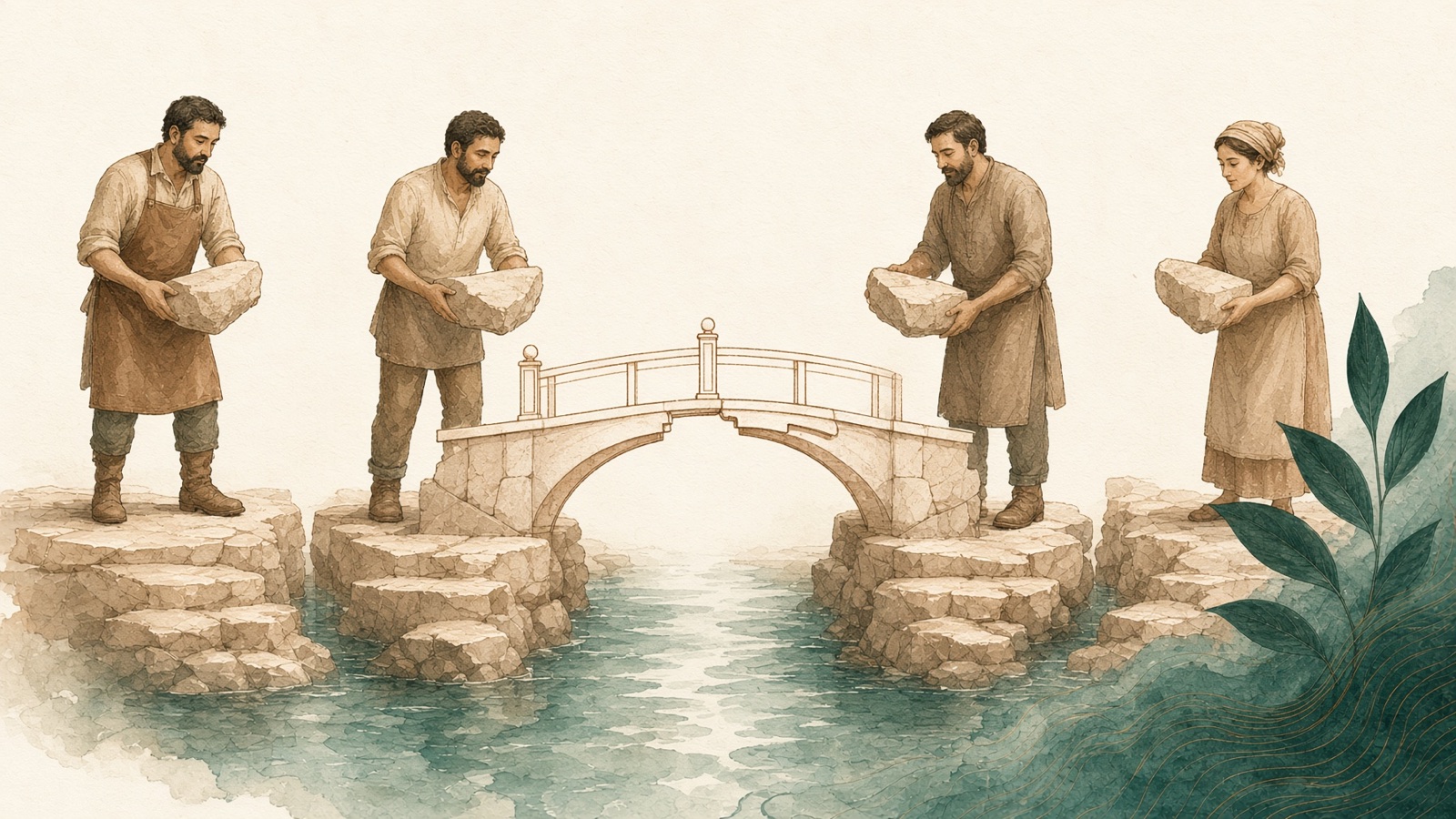
No one did it as a solo hero. Each brought a critical piece. Together those pieces are the Trust Society — the foundation — and the foundation is what lets a Generous Economy exist on top of it: generative, not extractive; everyone paid, no one owned. This is not a company's platform. It is a new world, and there is a seat for everyone who helped see it.
The foundation, and what it enables
Two ideas, in order. The first makes the second possible.
What changes, in one word
Every argument on this page reduces to a single difference — not in who owns the technology, but in which direction value travels. The extractive internet treats people as the raw material of someone else's balance sheet. A trust society treats them as the owners of what they produce.
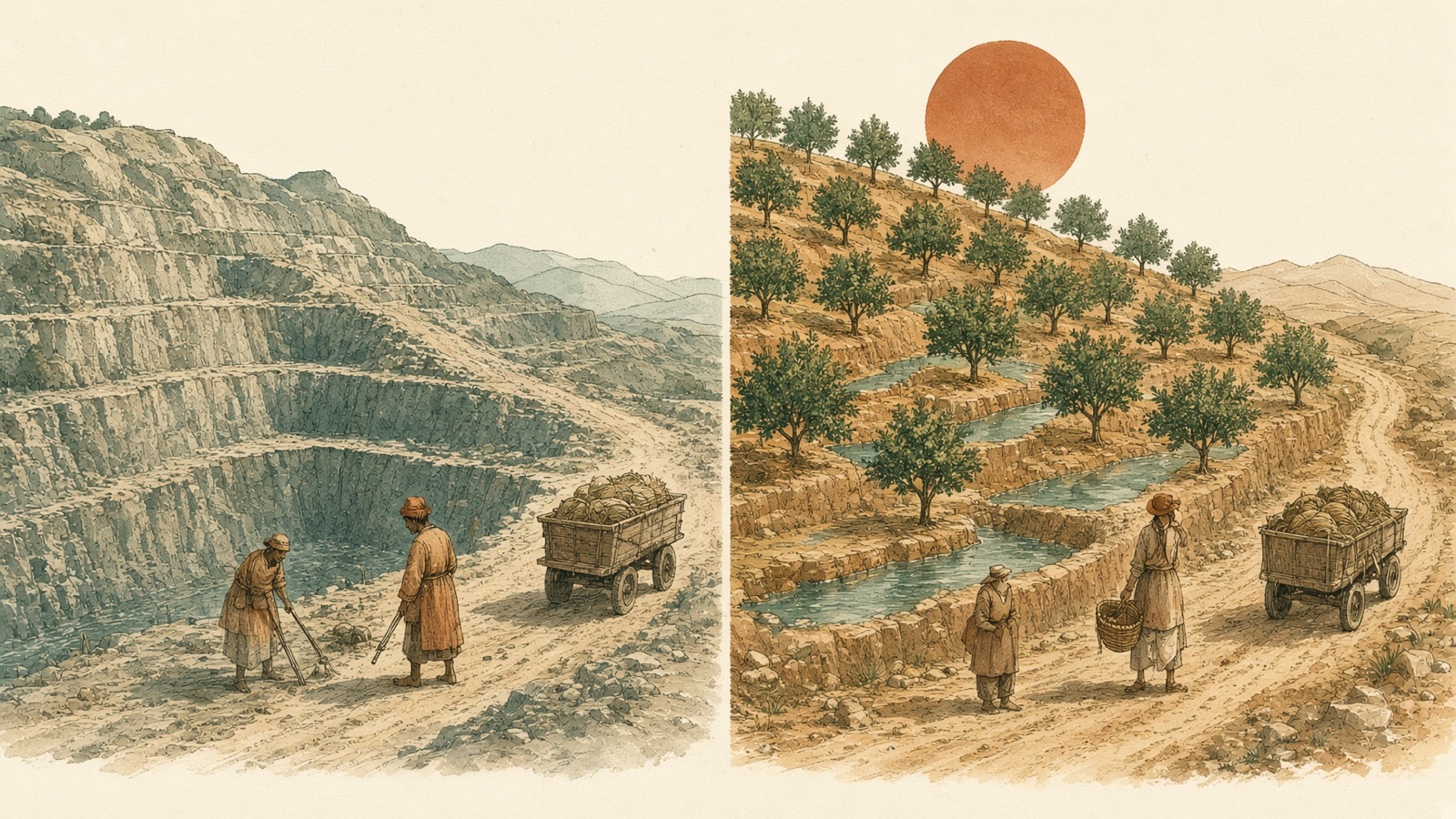
Nothing about the second picture is softer or more charitable than the first. It is simply built so that the people who create the value are the ones who keep it — which is what makes it last.
An identity you can keep
One key, held by you — the essence of a sovereign identity
The constitution — six principles, non-negotiable
The society is not a brand. It is a set of principles everyone agrees to honor — and the exact test the extractive internet fails. Nearly every player keeps one or two and quietly breaks the rest.
The part you live
Six principles are the law. This is the life.
The page so far tells you what the trust society guarantees, and who builds it. Here is what happens to you as your trust grows — three movements, each built on real mechanism, not roadmap.
Collaboration that grows with your trust.
The ladder isn't a pipeline you pass once — it's a progression you climb, and each rung widens exactly what you may do with other people. A low front door lets anyone in; power is earned rung by rung, bounded by your own trust, never an outsider's.
One gate enforces the whole climb — authorize(tier, action) — wired to real acts, not slogans: a settlement is a transact, and a stolen attestation can't move someone else's money. The rule underneath is simple and radical: the bound on your power is your trust — no more, no less.
The communities you join as you rise.
Trust isn't only personal — it's social. Belonging is a first-class object here, not an app feature: you join a collective once, and the trust graph itself derives who you may work with. Join once, reach everyone in the circle.
And circles assemble upward — a pair becomes a team, a team a community, then an institution, a region, a nation — the same structure at every scale, each boundary a trust gate. Trust doesn't leak between them, and it can be withheld at any level.
Make trustworthy collaboration cheap — and betrayal expensive.
One wallet that connects your whole economy.
What carries you across all of it is a single, person-owned vault — one vault, many shelves — holding your identity, your consent, and your value together. Its operator cannot decrypt it: physics, not a policy promise. It's the one surface every app plugs into, instead of each building its own silo of you.
Every partner connects to the same wallet by namespace. When your data creates value, the wallet pays you — 80% to the person, 10% the rail, 10% the commons, enforced at the rail and publicly witnessed. And the data never leaves: queries travel to the data through consented nodes; the data never travels to the query.
When someone buys access to a person's data, they pay the person.
Why these three complete the picture
The principles are the law. These are the life.
The six principles say what the society guarantees. Climb, Belong, and Carry say what it feels like to grow inside it — each one a principle, lived.
Trust & Personhood, as a progression — power earned rung by rung.
Recognition, as membership — circles that grow with you, gated and non-leaking.
Value, Privacy & Permission, in one place — the wallet that pays you and never leaks you.
You're not integrating a vendor. You join a trust fabric where your service plugs into one consent surface, inherits the cohort structure, and settles value back to people — and your standing grows as you're recognized, gate by gate.
You become sovereign at a low front door, and you rise — unlocking what you may do, the communities you may join, and a wallet that carries your identity, consent, and earnings across every app you touch.
The wallet you carry — the card you hold.
Sovereignty shouldn't be an abstraction you're told you have. It should be something you hold and see — a card in your wallet, next to your boarding pass, unmistakably yours, tied to your data, and verifiable everywhere.
Personhood
✓ Proven real
Trust rung
Transact · t3
Your value
$1,284 earned
Active consents
6 · all revocable
Connected shelves
Accountable to
Alex Rivera
Authorized for
Book appts · read Health
Consent scope
act · t2 · revocable
Attested
✓ live & audited
Two cards, one wallet — a person, and the AI that acts for them · no agent can ever wear a person's card
In your wallet — and verifiable everywhere.
The card lives where you already keep cards: issued as an Apple Wallet pass and a Google Wallet pass, presentable with a tap. It isn't a picture — it's the disclosure face of your vault, and the code on it carries a signed verifiable presentation anyone can check against one pinned root, offline. Built to open standards — W3C Verifiable Credentials / DID, the IEEE 2874 Profile, mDL — so everyone can verify it and no one owns the rail.
Consent, trust, and why we're called Rosalind
Consent as we implement it — not a checkbox. Permission is a cryptographic object that travels with your data: granular and per-purpose, so you grant one use and nothing more; enforced at the vault so a provider can query without ever extracting — the answer leaves, your data never does; revocable in an instant, with revocation that propagates; and every access attested, so there is a record you can read. When a doctor needs your history in an emergency, that is the difference between a form you signed years ago and a consent you hold and can withdraw.
Trust is earned and attested, not asserted. Nothing here asks you to take our word for it — claims are verifiable against a pinned root, offline, by anyone. The collaboration itself is the proof: the standard's author found a real gap in our implementation and we fixed it the same day. That is how trust compounds — in the open, between independent parties who check each other.

And why "Rosalind." We are named for Rosalind Franklin, whose work on the structure of life was taken and credited to others. That is not a logo; it is the reason attribution, consent, and person-owned data are load-bearing in everything we build. Rosalink exists so that what happened to her cannot happen to you: you hold the root, you grant the consent, and when your data creates value, the credit — and the value — return to you. We care about attribution because of who we're named after.
Everyone is welcome — because no one owns the door
The market has independently converged on this vocabulary in eight verticals at once. That is not a threat to defend against; it is proof the direction is right. We wired the street first and left the connections open — and the win, for all of us, is that trust composes across one shared substrate instead of fragmenting into a dozen private silos. Nothing here happens as a solo hero; it is possible as a collaborative symphony, and everyone who brought a piece shines.
- The Spatial Web standard (IEEE 2874) — its author defined the standard; we built the running implementation. The standard needs a real system; the system proves the standard. A match made in heaven.
- The architecture allies — Solid / Inrupt, Meeco, Verida, Spruce, Human.tech — each proved a piece of the model is real. None had to be beaten; each is a seat at the table.
- The builders inside the family — Abakus (with its Foundation) and the teams carrying the sovereign-banking and health work forward — everyone's piece, everyone's name.
The only condition of membership is the constitution above. Keep the six, and you are in — building on the same rail we run our own flagship on, verifiable by anyone, owned by no one.
A foundation is only worth what you build on it — and who builds it matters as much as what. No one raised this arch alone; it stands because an alliance of independent minds each set a stone and each kept their own franchise.
The Trust Society and the Generous Economy — the foundation, and what it makes possible.
The working stack is live today — Rosalind (sovereign health) · Abakus and its Foundation (sovereign banking) · RosaTrust (the trust engine underneath it all).
Owned by no one · anyone can verify it · no lock-in, ever.